


Sci-Fi & Fantasy
The Prequel to The Day of the Triffids... Edited by David Ketterer and Andy Sawyer. Introduction by David Ketterer
Liverpool, Liverpool University Press, 2009.
First edition thus. 8vo. Original boards. Dust-jacket.
A near-future thriller set in New York, where Nazis are plotting to create a race of conquering clones (SF Encyclopedia). Written around 1950, at the same time as The Day of the Triffids, it was rejected by publishers on both sides of the Atlantic. In 1951 Wyndham told his American agent Frederik Pohl that he had "messed about with the thing so much that I've lost all perspective", and he abandoned it.
Reviews were mixed. M. John Harrison found it "almost unreadable"; Leo Mellor in The Independent conceded it was not "an extraordinary lost masterpiece" but found it "fascinating"; and Jake Kerridge in The Daily Telegraph praised the way it anticipates Wyndham's later themes.


Sci-Fi & Fantasy
and other stories
London, Michael Joseph, 1975.
First hardback edition, first impression. 8vo. Original boards. Dust-jacket.
Twelve stories written between 1932 and 1960, ranging from Wyndham's early work for the American pulp magazines, under his earlier pen-names, to the postwar stories written as "John Wyndham". In the title story, as the jacket describes it, the great attraction on the planet Venus is an exhibition of creatures found preserved in the Valley of Dur, among them a man from Earth. Stranded on Venus through the treachery of his fellow men, he warns the Venusians to avoid all contact with an Earth ruled by two ruthless mineral companies. The collection was first published posthumously as a Sphere paperback, The Best of John Wyndham (1973)


Sci-Fi & Fantasy
A Tissue of Moonshine London, Methuen, 1902.First edition, first impression. 8vo. Original red cloth lettered in gilt.A fantasy romance. In 1899 a mermaid comes ashore on the south coast of England, takes the name "Miss Doris Thalassia Waters", and is received into a respectable family at Folkestone. Her purpose is Harry Chatteris, a rising politician she first encountered years before in the South Seas off Tonga. The novel mixes fantasy and romance with light social satire; Wells said it expressed his "craving for some lovelier experience than life had yet given me". John Clute has called it "the most complex thing Wells ever wrote". It was serialised in Pearson's Magazine (July–December 1901) before book publication by Methuen in 1902. The American edition (Appleton) followed in September 1902.


Sci-Fi & Fantasy
London, Michael Joseph, 1957.
First edition, first impression. 8vo. Original boards. Dust-jacket.
Wyndham's classic sci-fi novel, described by Margaret Atwood as his "chef d'œuvre", while the dramatist Dan Rebellato described it as "a searching novel of moral ambiguities" dealing with rape, abortion, motherhood, and the struggle between men and women quite as much as with alien invasion.


Sci-Fi & Fantasy
London, Macdonald, 1968.
First UK edition, first impression. 8vo. Original boards. Dust-jacket.
A collection of Larry Niven's "Known Space" stories; the title tale won the 1967 Hugo Award. This Macdonald printing is the first UK and first hardcover edition, the American original having appeared as a paperback.


Sci-Fi & Fantasy
London, T. Fisher Unwin, 1924.
First edition, first impression. 8vo. Original cloth. Dust-jacket, priced 7/6.
A Russian scientist invents a serum conferring immortality on selected recipients, and a young couple are left to decide whether it should be used; the protagonist's advocacy of the drug is brought to an end when the Wandering Jew appears and describes the cost of being unable to die. Harold E. Scarborough (1897–1935) was an American journalist and author resident in Britain from 1920, and this is the title for which he is remembered in science fiction. The book belongs to a distinct and long-running line of argument within the genre - that immortality would produce social sterility - running from Walter Besant's The Inner House (1888) through Martin Swayne's The Blue Germ (1918) and forward to Huxley's After Many a Summer (1939), and the Wandering Jew device places it equally in the Gothic tradition of Godwin's St Leon, Maturin's Melmoth the Wanderer and Mary Shelley's The Mortal Immortal. Noticed by Bleiler in Science-Fiction: The Early Years and Locke's A Spectrum of Fantasy. Published simultaneously in New York by D. Appleton.


Sci-Fi & Fantasy
London, Jonathan Cape, 1967.
First edition, first impression. 8vo. Original boards. Dust-jacket.
Nine of Ballard's short stories, drawn largely from the late 1950s and early 1960s, including 'The Concentration City,' 'Manhole 69' and 'Mr F. is Mr F.,' pieces generally regarded as key examples of his early psychological science fiction. The collection's story 'Minus One' was later adapted by documentary filmmaker Simon Brook as a short film.


Sci-Fi & Fantasy
London, Grant Richards, 1909.
'New and Cheaper Edition'. 8vo. Original pictorial cloth lettered in gilt to upper cover.
One of the author's posthumously published novels, relating the rivalry between two amateur astronomers in small-town American town who attempt to claim a surprisingly valuable comet.


Sci-Fi & Fantasy
Seattle, Darkside Press, 2003.
First edition, first impression. 8vo. Original boards. Dust-jacket.
A retrospective gathering of short fiction by John Wyndham, the first in a planned series of Darkside Press "readers" devoted to his shorter work, edited and introduced by John Pelan with story notes by Philip Stephensen-Payne. The 16 stories and novelettes span Wyndham's career from the 1930s to the '60s.


Sci-Fi & Fantasy
New York, Garden City, Doubleday & Company, 1969.
First edition, first printing. 8vo. Original cloth. Dust-jacket, priced $4.50.
The first edition of this novel set in a future 1992 where psychics are common and utilised in corporate espionage while intricate technologies allow recently deceased people to be maintained in a lengthy state of hibernation.


Sci-Fi & Fantasy
London, Chatto & Windus, 1932.
A pillar of the 20th century's dystopian architecture: Huxley acknowledged the book began as a parody of Wells's optimistic utopias, Men Like Gods specifically, before the joke deepened into the World State entire: Bokanovsky-processed embryos decanted by caste, soma, the feelies, Our Ford, and happiness administered until nothing human survives it.


Sci-Fi & Fantasy
London, Macmillan, 1906.
First edition, first impression. 8vo. Original cloth, lettered in gilt.
The gentlest apocalypse Wells ever arranged: a comet grazes the Earth, its green vapours dissolve into the atmosphere, and humanity wakes from "the Change" cured of jealousy, war fever, class hatred and the whole armature of pre-comet spite, narrated by a Midlands clerk who went into the Change murderous with sexual jealousy and came out of it sane.
The scandal was immediate and entirely deliberate: the transformed world's relaxed arrangements in love were read as an endorsement of free love, the Times Literary Supplement huffed, and Wells, then conducting his Fabian campaigns and his private life on similar principles, declined to reassure anybody.


Sci-Fi & Fantasy
London & New York, Harper & Brothers, 1899.
First edition, first impression. 8vo. Original cloth.
Graham falls into a trance in the 1890s and wakes two centuries on to find compound interest has done its patient work - he owns half the world, held in trust by a Council ruling a London of vast enclosed cities, moving ways, aeroplanes and a drugged, screen-fed proletariat. It is Wells pivoting from romance to dystopia, and the twentieth century took notes: the mega-city of Metropolis, and the administered futures of Zamyatin, Huxley and Orwell, all trace their plumbing here. Wells himself was dissatisfied enough to revise it in 1910 as The Sleeper Awakes.


Sci-Fi & Fantasy
and particularly how Mr. Bert Smallways fared while it lasted
London, George Bell & Sons, 1908.
First edition. 8vo. First state blue cloth, lettered in gilt to spine and upper cover.
Five years after Kitty Hawk, when powered flight could barely lift a man over a hedge, Wells wrote the book in which German airship fleets cross the Atlantic and bomb New York into ruin, air power dissolves the distinction between front and home, and civilisation, its trade and credit systems severed from above, simply stops. With A.C. Michael's plates, in the first state binding, an honest and attractive copy of the foundation stone of the aerial-warfare shelf.


Sci-Fi & Fantasy
London, Michael Joseph, 1953.
'Cheap Edition'. 8vo. Original boards. Dust-jacket, priced 6/-.
The phenomenon in its second wave: two years after publication, Joseph's 6/- cheap edition arrives to meet a demand the first printing plainly hadn't exhausted, with Penguin waiting in the wings - the bibliographical fossil record of a novel becoming a fixture.


Sci-Fi & Fantasy
London, Gollancz, 1987.
First UK edition, first impression. 8vo. Original boards. Dust-jacket.
A surprisingly rare edition of this Asimov collection, which includes one previously unpublished, new story.
"Presented in this volume are several previously uncollected stories, alongside a selection of vintage Isaac Asimov: such tales as 'Little Lost Robot', one of the best of his famous robot series; 'The Feeling of Power', in which Asimov anticipates by over twenty years the development of pocket computers; 'The Ugly Little Boy', a time travel story which may be the most moving tale he has ever written; and 'The Last Question', which Asimov himself chooses as his best story." (jacket blurb)


Sci-Fi & Fantasy
London, Michael Joseph, 1960.
First edition, first impression. 8vo. Original dark grey boards. Dust-jacket.
The last of the novels published in Wyndham's lifetime under the famous name at full stride, and the one whose reputation has travelled furthest: a lichen extract, the "antigerone," is found to slow human ageing - and the two discoverers split on what to do with two or three centuries of life. A thriller plot wearing a genuinely radical argument about gerontocracy, cosmetics and female emancipation; sixty years on it gets cited in bioethics discussions more than anything else he wrote. Very good in equally good Hugh Marshall wrapper.


Sci-Fi & Fantasy
Beynon (John, pseud. John Wyndham Parkes Lucas Beynon Harris, aka John Wyndham) Planet Plane
London, Newnes, [1936].
First edition, first impression. 8vo. Original cloth. Dust-jacket, priced 3/6.
Wyndham's third book and second science fiction novel. Written as John Beynon, it was serialised the same year in The Passing Show as Stowaway to Mars, abridged again in 1937 in Modern Wonder as The Space Machine, cut differently for a 1953 paperback, and finally restored in 1972 as Stowaway to Mars "by John Wyndham".
The plot: it is 1981, a million-pound prize awaits the first interplanetary flight, and a British millionaire launches the rocket Gloria Mundi from Salisbury Plain, bound for Mars. Once clear of the atmosphere the crew discover a stowaway, a woman, Joan Shirning, to their considerable period-typical consternation, carrying a strange tale of a machine of Martian origin. On Mars itself the book turns unexpectedly thoughtful: a dying race, and the machines destined to outlast it, a theme Wyndham was rehearsing fifteen years before anyone was paying attention. He revisited the story in the novella Sleepers of Mars (1938).


Sci-Fi & Fantasy
London, Michael Joseph, 1961.
First edition, first impression. 8vo. Original boards. Dust-jacket.
The mature Wyndham in short form, led by the novella that first appeared sandwiched between Golding and Peake in Sometime, Never (1956) and here gives its name to the collection: a woman wakes in a future without men, the male half of the species eliminated by an escaped virus; her amnesia making her the reader's guide to a society of castes and functions that works perfectly well, which is precisely the problem...

![Alternative view of Wyndham (John) Re-Birth [The Chrysalids]](https://lycanthiabooks.com/wp-content/uploads/2026/07/88377_2-300x300.jpg)
Sci-Fi & Fantasy
New York, Ballantine Books, 1955.
First US edition, first printing. 8vo. Original cloth. Dust-jacket.
The Ballantine Re-Birth actually precedes the Michael Joseph Chrysalids, making this less-lovely-titled US version the true first edition of the book many critics, and Wyndham's own editor at New Worlds, who thought it far superior to Triffids, regard as his masterpiece. Post-nuclear Labrador; a fundamentalist farming society whose scripture commands "Watch Thou for the Mutant"; crops burned and deviant babies cast out; and young David Strorm, who recites the creeds while concealing that he and a handful of children can speak mind to mind. It is the least typical of the major novels and the most perfectly made. A set text in British and Canadian schools for generations, and with the odd distinction of a rock afterlife: Jefferson Airplane's 'Crown of Creation' draws its lyrics directly from the novel's dialogue.
The texts differ, the American edition trimmed of some of the philosophical passages, so the completist perhaps needs both...but the priority belongs here, and Ballantine's mid-fifties hardcovers were tiny printings inside a paperback operation, making them far scarcer than their renown.


Sci-Fi & Fantasy
London, Rupert Hart-Davis, 1951.
First UK edition, first impression. 8vo. Original grey boards lettered in gilt to spine. Dust-jacket, priced 12s6d.
The first UK edition of Bradbury's famous 'Martian Chronicles', with slightly different content to the US edition and its coeval Argentinian counterpart.


London, Newnes, 1938-39.
3 issues (complete). Large 8vo. Original pictorial stapled wrappers.
Published by George Newnes Ltd, which paid respectable rates and obtained good-quality material, these three issues comprise a complete run of the magazine Fantasy, edited by T Stanhope Sprigg. The short-lived periodical included stories by significant authors such as John Wyndham, Eric Frank Russell and John Russell Fearn. John Beynon was one of the pseudonyms used by John Wyndham Parkes Lucas Beynon Harris (1903–1969), the British science fiction writer best known for The Day of the Triffids, The Kraken Wakes and The Midwich Cuckoos.


Sci-Fi & Fantasy
London, Burke, 1959.
First edition, first impression. 8vo. Original boards. Dust-jacket.
The fourth of MacVicar's 'Lost Planet' series, created for radio and also popular in book and TV versions - in these stories a pacifist theme came through strongly. The series was the first science fiction series ever translated into Hebrew, and had considerable impact on the development of the genre in Israel.


Sci-Fi & Fantasy
London, Burke, 1960.
First edition, first impression. 8vo. Original boards. Dust-jacket.
The fifth of MacVicar's 'Lost Planet' series, created for radio and also popular in book and TV versions - in these stories a pacifist theme came through strongly. The series was the first science fiction series ever translated into Hebrew, and had considerable impact on the development of the genre in Israel.


Sci-Fi & Fantasy
London, Rapp & Whiting, 1970.First UK edition. Ex-Library. 8vo. Original boards. Dust-jacket, priced £1.40.The first UK edition of this novel set in a future 1992 where psychics are common and utilised in corporate espionage while intricate technologies allow recently deceased people to be maintained in a lengthy state of hibernation.


Sci-Fi & Fantasy
A Romance of Marvel and Mystery
London, "Review of Reviews" Office, [1900].
The Masterpiece Library. 1. Edited by W. Stead. [bound in Hicklings' Almanack Handbook of Norfolk 1896] 8vo. Original printed red wrappers.
Stead's rare abridged edition of Haggard's gothic lost kingdom narrative set in the African interior, here intriguingly bound at the end of Hicklings' Norfolk Almanack for 1896. Stead was a pioneering investigative journalist and crusading newspaper editor, considered to be one of the most famous Englishmen to die in the sinking of the Titanic at the time. He launched the Masterpiece Library of Penny Popular Novels in 1893 and it eventually ran to about 100 novels. It was touted as 'the most efficient agency that has yet been devised for making our best literature familiar to the mass of the nation.' Punch dubbed the series "Penny Steadfuls". The novels were abridged into 30,000 to 40,000 words from novels which were originally six or eight times as long. They were, however, hugely popular with the much enlarged reading public of the time. She for example sold 500,000 copies in Stead's abridgement.

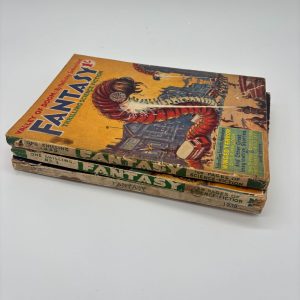
London, Newnes, 1938-39.
3 issues (complete). Large 8vo. Original pictorial stapled wrappers.
Published by George Newnes Ltd, which paid respectable rates and obtained good-quality material, these three issues comprise a complete run of the magazine Fantasy, edited by T Stanhope Sprigg. The short-lived periodical included stories by significant authors such as John Wyndham, Eric Frank Russell and John Russell Fearn. John Beynon was one of the pseudonyms used by John Wyndham Parkes Lucas Beynon Harris (1903–1969), the British science fiction writer best known for The Day of the Triffids, The Kraken Wakes and The Midwich Cuckoos.


Sci-Fi & Fantasy
A Grotesque Romance
London, C. Arthur Pearson, [c.1903/4].
'Cheap edition'. 8vo. Original yellow pictorial wrappers printed in red, priced 6'.
Originally published as a serial in Pearson's Weekly in 1897, then in book form the same year, this is a relatively rare edition of Wells' sci-fi classic, made more so by the presence of the fragile original wrappers.


Sci-Fi & Fantasy
London, Jonathan Cape, 1967.
First UK edition, first impression. 8vo. Original purple boards. Dust-jacket.
A pleasing first UK edition of Pynchon's second novel, simultaneously a satire of 1960s California counter-culture, a meditation on paranoia and information theory, and an unresolved mystery that deliberately withholds its own solution. Hard to find in such good order.
![[Tiphaigne de la Roche (Charles François)] Giphantia:](https://lycanthiabooks.com/wp-content/uploads/2026/05/88236-300x300.jpg)
![Alternative view of [Tiphaigne de la Roche (Charles François)] Giphantia:](https://lycanthiabooks.com/wp-content/uploads/2026/05/88236_2-300x300.jpg)
Sci-Fi & Fantasy
or a View of What Has Passed, What Is Now Passing, and, During the Present Century, What Will Pass, In the World
London, Robert Horsfield, 1761.
First edition in English. 2 vols. 8vo. Main title printed in red & black, part title with woodcut decoration. Uniformly bound by Glenn Malkin in modern speckled calf with geometric gilt design and blind-tooled roll & cogs decorations to covers, spines with raised bands and gilt rules with contrasting leather title labels. Housed in leather-backed marbled board compartmentalised slipcase.
A scarce imaginary voyage, considered to be one of the earliest works of utopian science fiction. This work is also considered a cornerstone book in any collection of photographic literature, and photography's first fictional work (see Roosens & Salu History of Photography, No. 10421).
Originally published in France in 1760 as Giphantie (an anagram of the author's name), this work is credited with one of the earliest mentions of photography, in Chapter 17: "That window, that vast horizon, those thick clouds, that raging sea, are all but a picture... Thou knowest that the ways of light, reflected from different bodies, make a picture and paint the bodies upon all polished surfaces, on the retina of the eye, for instance, on water, on glass. The elementary spirits have studied to fix these transient images; they have composed a most subtile matter, very viscous, and proper to harden and dry, by the help of which a picture is made in the twinkle of an eye... [the] impression of the images is made the first instant they are received on the canvas, which is immediately carried away into some dark place; an hour after, the subtile matter dries, and you have a picture so much the more valuable, as it cannot be imitated by art nor damaged by time" (pages 95-96).
Glenn Malkin began binding professionally in 2008 and has since won numerous awards for his design bindings in national and international competitions.


Sci-Fi & Fantasy
A novel
New York & Toronto, Farrar & Rinehart, 1937.
First edition, first printing. Cut signature of the author to title-page. 8vo. Original blue cloth decorated in silver. Dust-jacket, priced $2.50.
Two college friends visit their former university and find a professor burnt to death in his observatory.


Sci-Fi & Fantasy
A Novel
London, Secker & Warburg, 1949.
First edition, first impression. 8vo. Original cloth. Green dust-jacket, priced 10s.
A wonderful example of the first edition of Orwell's dystopian classic, benefiting from some skilful, minor restoration to remove a sticker mark from the jacket spine and improving the corners. Although many worthy experts suggest that the red jacket has historically proved to be the scarcer, it is our experience that the green one has proved equally difficult to acquire in recent years - worth noting that of ten jacketed first editions that appeared at auction in 2025, eight were in the red jacket.


Sci-Fi & Fantasy
London, Orbit, 1998.
First edition, first impression. Signed by the author on title-page. 8vo. Original boards. Dust-jacket.
An "attempt to write a Culture novel that wasn't", from the author of Consider Phlebas and (as Iain Banks) The Wasp Factory.


Sci-Fi & Fantasy
An enquiry into the limits of the possible
London, Gollancz, 1962.
First edition, first impression. 8vo. Original boards. Dust-jacket, priced 21/-.
Non-fiction essays where Clarke speculates on scientific and technological advances, from space flight and telecommunications to bioengineering, and coins the celebrated 'Clarke's Third Law' ("Any sufficiently advanced technology is indistinguishable from magic").


Sci-Fi & Fantasy
London, Gollancz, 1961.
First edition, first impression. 8vo. Original boards. Dust-jacket.
A tightly plotted, optimistic near-future thriller.


Sci-Fi & Fantasy
London, Gollancz, 1984.
First UK edition, first impression. 8vo. Original boards. Dust-jacket.
Set 1,500 years after God Emperor, the Bene Gesserit and a new faction, the Honoured Matres, are in conflict as the effects of Leto II's "Golden Path" continue to unfold.


Sci-Fi & Fantasy
London, Gollancz, 1978.
First UK edition, first impression. 8vo. Original boards. Dust-jacket.
On a sealed planet of extreme overcrowding, a human-Gowachin population has been subjected to a secret behavioural experiment by manipulative alien powers.


Sci-Fi & Fantasy
London, Gollancz, 1985.
First UK edition, first impression. 8vo. Original boards. Dust-jacket.
The final novel Herbert completed, in which the Bene Gesserit attempt to survive a galactic purge. Herbert died before writing the planned sequel.


London, Gerald G. Swan, 1960.
First edition, first impression. 8vo. Original blue cloth. Dust-jacket, priced 12/6.
A great first edition of this weird tale, an exploration into the power & peril of telepathy… The author was a prolific writer, with works ranging from children's fantasy to weird sci-fi and spy fiction.


Sci-Fi & Fantasy
[Selected Works]. Foreword by Emil Petrov
Sofia, , 1958.
First Bulgarian edition, limited to 8000 copies. Signed presentation copy from the author. 8vo. Printed in Bulgarian. Original terracotta cloth.
Signed and warmly inscribed by Svetoslav Minkov on the half-title in Bulgarian, the inscription translates as: "To good friends Brigitte and Peter, with much warmth and devotion - Sv. Minkov, London, 29.11.60." The recipients were the Bulgarian author & journalist Brigita Yosifova, and the British poet & translator Peter Tempest - an inscription that speaks to Minkov's literary friendships and his continuing engagement with intellectual circles beyond Bulgaria.This is a scarce collected selection by one of the most distinctive voices in 20th-century Bulgarian literature. A central figure in Bulgaria's interwar avant-garde, Minkov introduced the grotesque, the fantastic, and speculative futurism into a literary culture largely shaped by realism & social narrative. His coolly ironic prose, fascination with technology and sharp sense of the absurd place him in dialogue with the broader European modernist tradition; he is frequently regarded as the father of Bulgarian science fiction & horror. Themes of mechanisation, alienation and the fragility of identity run through his work, lending it a striking modernity that still resonates.The volume is arranged in four sections: first, twenty-five short stories — including his celebrated The Lady with the X-Ray Eyes, alongside The Hydrogen Gentleman and the Oxygen Girl, The Woman in the Golden Coffin, and others; secondly, a group of travelogues; thirdly, fairy tales; and finally, a series of feuilletons and satirical sketches, which display his characteristic wit and satirical edge.Svetoslav Minkov (1902-66) travelled extensively across Europe, Asia, and South America both before and after the Second World War. He worked as a journalist for several Communist newspapers and later served in an official capacity within the Bulgarian government's cultural office, navigating a complex cultural landscape while maintaining a voice that remained distinctly his own.


Sci-Fi & Fantasy
London, Alston Rivers, 1928.
First edition, first impression. 8vo. Original cloth. Original upper and lower panel of the dust-jacket cut-down and loosely inserted.
Although better known as a writer of crime fiction, this sole venture into science fiction by Grierson does make it one of his more collectable titles. The book is cited in Gerber's Utopian Fantasy (1973), Negley's Utopian Literature: A Bibliography, Sargent's British and American Utopian Literature, and Bleiler (1978), and is considered scarce.


Sci-Fi & Fantasy
London & New York, Frederick Warne, 1890.
First UK edition. 8vo. Contemporary, presumed institutional, red cloth binding, gilt to spine.
The first edition of this significantly influential work of fin-de-siècle science fiction. The story follows a diverse group of idealistic explorers who travel to Mars in a steel sphere powered by an anti-gravity device. They discover a peaceful, co-operative utopia, promptly find it intolerably dull, and attempt to remake it along capitalist and imperial lines, with predictably disastrous results. The book later attracted controversy through a dubious claim of a foreword by Jules Verne and legal action by the author against H.G. Wells for alleged plagiarism. An important and unsettling anti-utopian work, ending in a fashion as extreme as anything in early science fiction.