


African literature
London, Heinemann, 1965.
First edition, second impression. Signed presentation copy from the author. 8vo. Original boards. Dust-jacket.
Chinua Achebe's third novel, set in 1920s colonial Nigeria: Ezeulu, chief priest of Ulu for the six Igbo villages of Umuaro, refuses to call the New Yam Feast, with ruinous consequences as missionary and colonial pressures grow. Part of Achebe's African Trilogy with Things Fall Apart and No Longer at Ease, it won the first Jock Campbell/New Statesman Prize. Achebe (1930–2013) signed this copy.


African literature
London, Heinemann, 1965.
Uncorrected proof copy. 8vo. Original green & white wrappers printed in black, with publisher's ink stamp to upper wrapper.
Achebe's fourth novel is a satire of political corruption in an unnamed West African state, narrated by the young schoolmaster Odili as he turns against his former teacher, the venal cabinet minister Chief Nanga. Achebe (1930–2013) remains the foremost figure of modern African letters, the founder of Heinemann's 'African Writers' series and author of Things Fall Apart (1958), and went on to win the Man Booker International Prize in 2007.


African literature
London, Faber & Faber, 1946.
First edition, second impression. 8vo. Original cloth. Dust-jacket.
"...the story of a brilliant West African boy and his search for what he conceived to be success by Western standards. We watch with delight young Folu's progress through the mission school, where by his shrewdness and wit he quickly makes his mark." (jacket blurb)


African literature
Nairobi, East African Publishing House, 1966.
First edition. 8vo. Original wrappers.
An extended narrative poem in the voice of Lawino, a rural Acholi woman in Uganda, who laments that her husband Ocol has taken a Westernised mistress and abandoned his own cultural identity. The work founded what is now known academically as the "Okot School" or "East African Song School" of poetry.


African literature
Zambia, , September, 1964.
Vol.I No.I. 8vo. Original printed wrappers.
New Writing from Zambia was a foundational publication of Zambia's literary culture in English, started in 1964 just prior to Zambia's independence by the New Writers Group - a small cosmopolitan grouping of educationalists, journalists and enthusiasts eager to kick-start a Zambia-based literary culture in English. The journal ceased publication in 1975, during which period it published the works of more than 150 authors. The first issue includes contributions by E.M. Chipimo, Kelvin Mlenga, William Mukone and F.O. Bennett.


African literature
Poems... Foreword by Nadine Gordimer
Johannesburg, Renoster Books, 1971.
First edition, first impression. 8vo. Original pictorial wrappers.
A notable work in the history of the anti-apartheid movement, produced at a time when most authors associated with the movement were banned or exiled. Mtshali, who at the time worked as a messenger in Johannesburg, has since been credited with spawning the Black Consciousness Movement in South Africa. Jensma was a significant and troubled South African artist and poet whose own work is now keenly collected.


African literature
London, Hutchinson, 1962.
First edition, first impression. 8vo. Original black boards. Dust-jacket, priced 16s.
Onuora Nzekwu was a Nigerian author and educator, known for his works that explored Nigerian society and culture.


African literature
The Roots of Revolt
London, Lawrence & Wishart, 1960.
First edition, first impression. 8vo. Original cloth. Dust-jacket, priced 21s.
An influential socio-political study examining land tenure, labour exploitation and the economic foundations of anti-colonial movements across Africa.


African literature
(Nongquase the Liberator)
[Eastern Cape], Lovedale Press, [1955].
First edition. 8vo. Original blue wrappers printed in black.
The scarce first edition of this play by one of the founding fathers of South African literature, Herbert Isaac Ernest Dhlomo, taking as its subject the prophet Nongquase who triggered the devastating Xhosa cattle-killing movement and famine (1854–1858). The Lovedale Press was born from a mission created in the 19th century just north of Alice in the Eastern Cape; it primarily produced religious publications but did also champion black writers and political thinkers, including among its alumni journalist Daisy Makiwane, poet Isaac Williams Wauchope, musician & composer John Knox Bokwe, and anti-apartheid activist Steve Biko.


African literature
Homecoming of a Negro from Eton
London, Satellite Books, 1978.
First edition, first impression. 8vo. Original boards. Dust-jacket, priced £3.50.
Autobiographical account of Onyeama's return to Nigeria after his schooling at Eton, reflecting on race, cultural identity and the psychological legacy of institutional racism. A key work in Black British/West African postcolonial life-writing, now widely recognised as historically important testimony.


African literature
Du Plessis (Phil), Stephen Gray, Wilma Stockenström, Wessel Pretorius, editors. IZWI.
VOICE/STEM
Johannesburg, IZWI, 1st December 1973.
Vol.3 No.13. 4to. Original pictorial wrappers.
IZWI (Voice/Stem) was an avant-garde South African literary-arts magazine published from Johannesburg (specifically Crown Mines), notable for its community of writers and artists operating outside mainstream (i.e., apartheid) norms. It's culturally significant for its role in fostering South Africa's literary counter-culture, its aesthetic and socio-political commentary marking a shift from earlier European-derived poetic forms to distinctive Southern African voice.


African literature
London, Rex Collings, 1981.
First edition, first impression. 8vo. Original boards. Dust-jacket.
Aké: The Years of Childhood is a 1981 memoir by Nigerian writer Wole Soyinka.


African literature
The Roots of Revolt
London, Lawrence & Wishart, 1960.
First edition, first impression. Signed by the author. 8vo. Original cloth. Dust-jacket, priced 21s.
An influential socio-political study examining land tenure, labour exploitation and the economic foundations of anti-colonial movements across Africa.


African literature
London, Faber & Faber, 1958.
First edition, first impression. 8vo. Original cloth. Dust-jacket, priced 18s.
The story follows Adebisi, an 18-year-old huntress who embarks on a quest to find her four brothers lost in the Jungle of the Pygmies, facing various supernatural challenges. Amos Tutuola (1920–1997) was a Nigerian writer known for incorporating Yoruba folklore into his works. His debut novel, The Palm-Wine Drinkard, gained international acclaim.


African literature
London, Hutchinson, 1961.First edition. 8vo. Original black boards. Dust-jacket, priced 16s.The first novel by Nigerian author Onoura Nzekwu, later republished by Heinemann as part of the important African Writers Series. The novel has been compared to Achebe's No Longer at Ease.


African literature
London, André Deutsch, 1964.
First edition. 8vo. Original green boards. Dust-jacket, priced 18s.
The first edition, preceding the Heinemann African Writers Series edition, of the author's first novel. An experimental novel, Okara delves into themes of identity, colonialism and the conflict between modernity and traditional African values.


African literature
Blomerus (Marié), Phil du Plessis & Hugo Neirinckx. Wurm 8 [Cover design by Wopko Jensma]
Pretoria,, Wurm, March 1968.
8vo. Original stapled pictorial wrappers.
Wurm was a South African avant-garde literary periodical, with this the eighth issue published in March 1968. This edition was co-edited by Marié Blomerus, Phil du Plessis, and Hugo Neirinckx, and featured illustrations by notable artists such as Anna Vorster, Walter Battiss and Wopko Jensma.
Wurm emerged during the 1960s as a platform for experimental Afrikaans literature, embracing concrete and visual poetry, and fostering connections with the international avant-garde. From its fifth issue onward, under the editorial leadership of Blomerus and du Plessis, the magazine expanded its scope to include interviews with visual artists and a broader range of literary forms. The magazine's open editorial policy attracted young, free-thinking individuals, particularly Afrikaans speakers critical of the state and government policies.
The publication's name, Wurm, was inspired by a poem by Eugène Marais titled "The Soul of the White Ant," symbolizing a worm demolishing the walls of establishment—a metaphor for challenging the foundations of traditional Afrikaans literature.


African literature
London, Jonathan Cape, 1961.
First edition, first impression. 8vo. Original cloth. Dust-jacket, priced 15s.
This debut novel by Ronald Harwood is set in Cape Town and follows George, a Zulu houseboy, who faces exploitation by the white families he serves.


African literature
London, Faber & Faber, 1958.
First edition, first impression. 8vo. Original cloth. Dust-jacket, priced 18s.
The story follows Adebisi, an 18-year-old huntress who embarks on a quest to find her four brothers lost in the Jungle of the Pygmies, facing various supernatural challenges. Amos Tutuola (1920–1997) was a Nigerian writer known for incorporating Yoruba folklore into his works. His debut novel, The Palm-Wine Drinkard, gained international acclaim.


African literature
London, Heinemann, 1969.
First edition, first impression; review copy with publisher's printed slip. 8vo. Original green boards. Dust-jacket, priced £1.50.
The novel centers on a dispute between two villages over ownership of a pond, leading to escalating tensions and conflict. It explores themes of tradition, community, and the consequences of pride and stubbornness.


African literature
London, Fourth Estate, 2006.
First edition. Signed by the author. 8vo. Original boards. Dust-jacket, priced £14.99.
Signed by the author on the title-page. This prize-winning novel tells the story of the Biafran War through the perspective of the characters Olanna, Ugwu, and Richard. Subsequently made into a film.


African literature
London, Fourth Estate, 2004.
First UK edition, first impression. Signed by the author. 8vo. Original boards. Dust-jacket.
A coming-of-age novel that follows 15-year-old Kambili Achike in post-colonial Nigeria. Adichie's works, including Half of a Yellow Sun and Americanah, have received critical acclaim and numerous awards.


African literature
London, Harvill, 1970.
First edition, first impression. 8vo. Original cloth. Dust-jacket, priced £1.50.
Chukwuemeka Ike (1931–2020) was a Nigerian writer known for his satirical novels that often critiqued societal issues. His works blend humor with serious commentary on African society and traditions.


African literature
London, Macgibbon & Kee, 1935.
First edition, first impression. 8vo. Original green cloth. Dust-jacket, priced 16s.
The Jumbie Bird explores the cultural and social dynamics of Indo-Caribbean life, focusing on themes of identity, tradition, and the immigrant experience. The narrative delves into the complexities of maintaining cultural heritage while adapting to new environments.


African literature
London, Andre Deutsch, 1975.
First edition, first impression. 8vo. Original boards. Dust-jacket, priced £3.25 (scored through).
This satirical novel critiques the post-colonial Nigerian elite, highlighting themes of materialism and societal change. The narrative follows characters navigating the complexities of status and identity in a rapidly evolving society.


African literature
London, Herbert Jenkins, [1960].
First edition. 8vo. Original red boards. Dust-jacket, priced 12/6.
An attractive first edition of this important work on colour politics in South Africa.


African literature
Boston, Houghton Mifflin, 1968.
First edition, first printing. 8vo. Original black cloth. Dust-jacket, priced $4.95.
First edition of the renowned debut novel by Ghanaian writer Armah, subsequently republished in the influential Heinemann African Writers Series in 1969. The novel tells the story of an unnamed man who struggles to reconcile himself with the reality of post-independence Ghana.


African literature
London, Jonathan Cape, 1948.
First edition. 8vo. Original cloth. Dust-jacket, priced 9s6d.
Paton's searing indictment of South African society, published on the eve of the South African government formally institutionalising apartheid, one of the best-known and most acclaimed works in South African literature.


African literature
London, Dorothy Crisp, [c.1946].
First edition. 8vo. Original green cloth. Dust-jacket, priced 8s 6d.
First published in South Africa in 1946, Peter Abrahams' classic novel Mine Boy exposed South Africa's fledgling racial apartheid system and townships to the world - and its wisdom, vividness and political power endures to this day.


African literature
London, Heinemann, 1960.
First edition. 8vo. Original cloth. Dust-jacket, priced 13s6d.
The first edition of this tale of Lagos corruption by Nigerian writer Achebe, the scarce second volume in his landmark 'African trilogy'.


African literature
Durban, The Knox Publishing Company, 1944.
First edition. 8vo. Original cloth-backed boards. Dust-jacket, priced 4/-.
"An enchanting tale of Matambo, a hero of the Matabele people..." (jacket blurb). Scarce.


African literature
London, Dorothy Crisp, [c.1946].
First edition. 8vo. Original green cloth. Dust-jacket, priced 8s 6d.
First published in South Africa in 1946, Peter Abrahams' classic novel Mine Boy exposed South Africa's fledgling racial apartheid system and townships to the world - and its wisdom, vividness and political power endures to this day.


African literature
Johannesburg, A.P.B. Bookstore, 1947.
First edition. 8vo. Original brown cloth. Dust-jacket.
A solid first edition of this the second book (of three) published in the author's life-time. Bosman is widely regarded as South Africa's greatest short-story writer.


African literature
A Journal of African and Afro-American Literature. No.15
Ibadan, Nigeria, For Mbari Club by Longmans of Nigeria, August 1964.
Small folio. Original pictorial wrappers.
An attractive issue of this seminal West African literary journal, with cover design by Jacob Afolabi.
"The steady development of Black Orpheus over the last seven years amounts to a remarkable achievement. It has succeeded in breaking the vicious circle that seems to inhibit the development of a proper reading public by its continued existence, by its very availability; more than that, it has also gone on to establish itself as one of the most important formative influences in modern African literature.…It can be said, without much exaggeration, that the founding of Black Orpheus, if it did not directly inspire new writing in English-speaking Africa, at least coincided with the first promptings of a new, modern, literary expression and re-inforced it by keeping before the potential writer the example of the achievements of the French-speaking and Negro American writers." (Abiola Irele, editor, Journal of Modern African Studies). The magazine ceased publication in 1975.


African literature
London, Grayson, 1932.
First edition. 8vo. Original blue cloth. Dust-jacket, priced 7/6.
A collection of particularly good short stories of Africa, the mysterious, elusive, charming, fascinating and cynical. Previously published in Blackwood's magazine.


African literature
London, Heinemann, 1958.
First edition, first impression; 8vo. Original brick-red cloth. Dust-jacket, priced 15s.
The first edition of Nigerian author Achebe's first novel, one of the BBC's '100 Novels That Shaped Our World'. Things Fall Apart is the first part of the author's 'African Trilogy', a compelling story of one man's battle to protect his community against the forces of change, seen as the archetypal modern African novel in English, and one of the first to receive global critical acclaim. It is a literary staple of schools throughout Africa and is widely read and studied in English-speaking countries around the world. Scarce.


A Journal of African and Afro-American Literature. No.10
Ibadan, Nigeria, General Publications Section, Ministry of Education, [1962].
Small folio. US distributor's label to copyright page. Original pictorial wrappers.
An attractive issue of this seminal West African literary journal. Includes a section on 'New Nigerian Poetry'.
"The steady development of Black Orpheus over the last seven years amounts to a remarkable achievement. It has succeeded in breaking the vicious circle that seems to inhibit the development of a proper reading public by its continued existence, by its very availability; more than that, it has also gone on to establish itself as one of the most important formative influences in modern African literature.…It can be said, without much exaggeration, that the founding of Black Orpheus, if it did not directly inspire new writing in English-speaking Africa, at least coincided with the first promptings of a new, modern, literary expression and re-inforced it by keeping before the potential writer the example of the achievements of the French-speaking and Negro American writers." (Abiola Irele, editor, Journal of Modern African Studies). The magazine ceased publication in 1975.


African literature
Ibadan, Mbari Publications, 1964.
First edition. 8vo. Original pictorial wrappers.
Inspired by the songs and verse traditions of the author's native Ewe people, this marked the publishing debut of the Ghanaian poet and author Williams, also known as Kofi Awoonor. Uncommon in this condition.

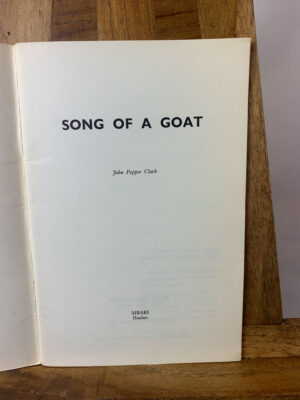
African literature
Ibadan, Mbari Publications, 1961.
First edition. 8vo. Original pictorial wrappers.
The Nigerian author's first published dramatic work, scarce in such condition. Clark (1935 - 2020) played an important role in the evolution and dissemination of African literature, not least as the co-editor of the Pan-African magazine Black Orpheus.


African literature
Ibadan, Mbari Publications, 1961.
First edition. 8vo. Copyright stamp to verso of title. Original pictorial wrappers, barcode sticker to foot of spine.
The Nigerian author's first published book of poetry, scarce in such condition. Clark (1935 - 2020) played an important role in the evolution and dissemination of African literature, not least as the co-editor of the Pan-African magazine Black Orpheus.


African literature
Introduction by Oliver Tambo. Edited by Ruth First
London, Heinemann, 1965.
First edition. 8vo. Original black boards lettered in gilt. Dust-jacket.
A very good first edition of Mandela's collected early writings, including his famous speech at the Rivonia Trial (1964). Distinctly uncommon, preceding his autobiography Long Walk to Freedom by almost thirty years.


African literature
London, Hutchinson, 1961.
First edition. 8vo. Original black boards. Dust-jacket, priced 16s.
The first novel by Nigerian author Onoura Nzekwu, later republished by Heinemann as part of the important African Writers Series. The novel has been compared to Achebe's No Longer at Ease.