


Fairy & Folktales
London, Constable, 1936.
First edition, first impression. Presentation copy from the author. 8vo. Original cloth. Dust-jacket, priced 7/6.
A collection of tales, fables, ballads and verse, with a short play, which Naomi Mitchison described (as the jacket quotes) as "stories about Between-ness which happen in the Debateable Land, the uncharted marches between here and Fairy Land". Traditional tales are reworked for the 1930s: the title story is a dark sequel to "The Three Little Pigs"; there are new versions of "Hansel and Gretel" and "The Little Mermaid"; a witch's Rolls-Royce draws up in Corporation Street, Birmingham, to lure the children of unemployed workmen to "the dangerous house of Capital"; the Snow Maiden lives in the back street of a commercial town and marries a commercial traveller; and the play Kate Crackernuts deals with fairy abduction. The SF Encyclopedia notes the book's use of fantasy for allegory. It was reissued by Princeton University Press in its "Oddly Modern Fairy Tales" series, with an introduction by Marina Warner.
A presentation copy, inscribed "Gerald, with love from Naomi, as always", with "(Heard)" added above the name in a different hand. Gerald Heard (1889–1971), writer and philosopher and the BBC's first science commentator, was a mentor to Aldous Huxley and Christopher Isherwood, and emigrated to the United States with the Huxleys in 1937. Mitchison was a friend of his and took part in his Engineers' Study Group (founded 1931), but their friendship ended after 1936 when they disagreed over the Spanish Civil War: Mitchison backed the Republicans, while Heard refused to take sides in any war. The book was published in 1936, shortly before the break.


Fairy & Folktales
collected by the Brothers Grimm. Newly Translated
London, Routledge, Warne, & Routledge, 1864.
8vo. Original blind-tooled red cloth with gilt decoration to upper cover and spine.
The Wehnert translation, first published by Addey & Co. in two volumes in 1853 with 240 illustrations, and the version through which several generations of English readers first encountered all things Grimm. It has a long afterlife: Frances Jenkins Olcott, editing the tales for Harrap in the 1920s, still acknowledged this "quaint old-fashioned translation, illustrated with woodcuts by Wehnert" as a source of folk phraseology alongside the more scholarly Margaret Hunt text of 1884.

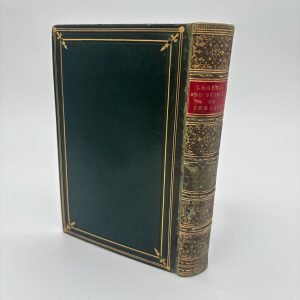
Fairy & Folktales
London, Chapman & Hall, '1878' (manually added in ink).
'New Edition'. 8vo. Full green calf, gilt roll borders with cornerpieces to covers, spine elaborate gilt compartments with contrasting leather title label.
Samuel Lover (1797–1868) was an Irish songwriter, composer, novelist, and portrait painter, chiefly in miniatures. He first published Legends and Stories of Ireland in 1832, illustrated by himself, drawing on his knowledge of rural Ireland, its customs and characters. A fine binding.


Fairy & Folktales
London, Naldrett Press, 1954.
First edition, first impression. 8vo. Original boards. Dust-jacket.


Fairy & Folktales
London, Lindsay Drummond, 1949.
First edition, first impression. 8vo. Original cloth. Dust-jacket, priced 12/6.
A collection of the stories told by the Arab Tribes of the Lower Euphrates.