
![Airmail Information In Connection with the Voyage of the Airship "Graf Zeppelin" from Germany via Brazil to "A Century of Progress" Exposition in Chicago...and return to Europe, [1933]](https://lycanthiabooks.com/wp-content/uploads/2026/10/88650-300x300.jpg)
In Connection with the Voyage of the Airship "Graf Zeppelin" from Germany via Brazil to "A Century of Progress" Exposition in Chicago...and return to Europe
New York, Luftschiffbau Zeppelin G.m.b.H., [1933].
Printed broadside, framed & glazed.
A printed broadside issued in New York by Luftschiffbau Zeppelin for the 1933 flight of the airship Graf Zeppelin (LZ 127) from Germany, via Brazil, to the "A Century of Progress" Exposition in Chicago and back to Europe. It sets out the planned schedule: departure from Friedrichshafen on 14 October, by way of Pernambuco and Rio de Janeiro to Miami and Akron, a 20–24-hour flight to Chicago and back, then return via Seville to Friedrichshafen on 31 October. It also gives detailed postal rates and instructions for collectors wishing to send mail by the airship, using German, Brazilian or United States stamps. It announces the special United States 50-cent airmail stamp issued for the visit, noting that "only a limited amount of these stamps will be printed and the plates subsequently destroyed". This is the stamp now known to collectors as the "Baby Zepp" (Scott C18), issued on 2 October 1933.
The Graf Zeppelin reached the Chicago fair on 26 October 1933, circled it for some two hours, and made a brief landing. This was the fifth and last of the airship's visits to the United States. By 1933 the Nazis had come to power, and the airship carried swastika markings on the left side of its fins; its commander, Hugo Eckener, circled the fair clockwise so that spectators would not see them. The flight came during the airship's regular South American service: it had made 64 round trips to Brazil by the time it was retired in 1937.


With a chapter on the evolution of medical opinion
London, H.K. Lewis, 1925.
First edition, first impression. 8vo. Original cloth. Dust-jacket.
A study of the therapeutic use of alcohol, "with a chapter on the evolution of medical opinion", by Courtenay C. Weeks, M.R.C.S., L.R.C.P. Weeks was a surgeon and a director of the National Temperance League. He had already published "The Use of Alcohol in Hospital Practice" in the British Journal of Inebriety (1924), and he followed the present book with Alcohol and Human Life (1929). A recent historian of interwar drinking describes that book as an influential polemic against the "new moderationism" then gaining ground in medical opinion, and quotes Weeks's warning against "the ghastly evil of alcoholism … the greatest single enemy Britain has to fear". Reviewers of the time were less persuaded: The Lancet advised restraint in view of his "enthusiastic conviction that alcohol is wholly evil".The book belongs to the long debate over the prescription of alcohol by doctors, which was still active in the 1920s. Published by H. K. Lewis, the London medical publishers, and in the original plain typographic jacket, priced 3s. 6d.
![[Exercise Eskimo]. Canadian Army and Air Force Winter Warfare Research Programme, 1945 - third image](https://lycanthiabooks.com/wp-content/uploads/2026/10/88616_3-300x300.jpg)
![[Exercise Eskimo]. Canadian Army and Air Force Winter Warfare Research Programme, 1945](https://lycanthiabooks.com/wp-content/uploads/2026/10/88616-300x400.jpg)
1944 [-] 1945 Exercise Eskimo "Dry Cold". Ottawa, Department of National Defence, 1945.Vol.I & II (only, of 3), 8vo. Original pictorial cloth.Two volumes of rare military technical reports documenting Exercise Eskimo, a significant joint winter warfare field trial conducted in northern Canada during the final stages of World War II. Involving approximately 1,750 personnel from the Canadian Army and the Royal Canadian Air Force, the exercise was designed to test the impact of sub-Arctic winter conditions on combat efficiency and military equipment across a wide range of operational areas — from clothing, rations, and the army postal service to tanks and heavy machinery. The volumes compile core observations, technical data, prototype equipment evaluations, and formal recommendations for future winter operations, and are illustrated with photographs throughout. One volume includes five large fold-out maps in rear pockets covering the Advance, Withdrawal, Lines of Communication Operations, Air Operations, and Winter Climatic Zones.


Non-Fiction
An Anthropological Interpretation of Sadism, Masochism, and Lycanthropy...a lecture delivered at a meeting of the Royal Society of Medicine
London, Routledge and Kegan Paul, 1951.
First edition, first impression. 8vo. Original boards. Dust-jacket.
Robert Eisler's singular study tracing sadism, masochism and werewolf legend to humanity's shift from herbivore to hunter, delivered as a Royal Society of Medicine lecture and introduced by the psychiatrist Sir David K. Henderson. A cult text in the literature of lycanthropy.


Non-Fiction
The facts behind the present crisis
London, W.F.T.U. Publications, 1952.
Second impression. 8vo. Original pictorial wrappers.
An anonymous agitprop pamphlet from the Soviet-aligned World Federation of Trade Unions, setting out "the facts behind the present crisis" in Kenya at the outbreak of the Mau Mau Emergency. Early Cold War anti-colonial ephemera.


Non-Fiction
London, for The Kenya Committee, [1954/5].
8vo. Original pictorial wrappers.
A Kenya Committee pamphlet by Ralph Millner, its cover a striking barbed-wire linocut by Bagley. The London-based Committee campaigned against British conduct during the Mau Mau Emergency; title and imagery frame it as a civil-liberties protest on behalf of Kenya's Africans. Uncommon protest ephemera.


Non-Fiction
London, Fabian Colonial Bureau, [1950].
8vo. Original printed wrappers.
A Fabian Colonial Bureau pamphlet by Marjorie Nicholson surveying the nationalist and political "ferment" across Britain's West African colonies at mid-century. Scarce socialist colonial-policy ephemera.


Non-Fiction
London, The Sheldon Press [for the SPCK], 1934.
First edition, first impression. 8vo. Original cloth. Dust-jacket.
The author argues "along strictly scientific lines" for the insufficiency of a merely mechanistic theory of the universe, marshalling physiological, embryological, psychological and astronomical evidence toward a spiritual interpretation that affirms both the existence and the moral character of God and the survival of the human soul - a work of natural theology pitched deliberately at the general reader and independent of scriptural revelation. Issued by the Sheldon Press, the publishing house of the SPCK, it carried notable endorsements: Sir Oliver Lodge found its philosophy "in many respects akin to my own," and it drew approving notices from the Oxford zoologist E. B. Poulton, the King's College physiologist W. D. Halliburton, the British Medical Journal and The Lancet.
![F.W. Rose, Serio-Comic War Map for the Year 1877, revised edition, [1877]](https://lycanthiabooks.com/wp-content/uploads/2026/09/88562_2-300x228.jpg)
Revised Edition London, G.W. Bacon, [?1877].Colour lithographic allegorical map, with printed explanation to lower right in English only; 570 x 430 mm., backed onto card.The first slightly revised edition of Rose's famous 'Octopus' map of Europe, first published in 1877 - the map was rapidly reissued for distribution in other countries, reflected in the imprint and the language of the attendant description. Rose is best known for two such political cartoon maps of Europe, this one and Angling in Troubled Waters (1899). Most of his maps were published as broadsheets and separate folding publications on relatively thin paper, and as a result rarely appear in particularly good condition.Russia sprawls across the continent as a monstrous octopus, tentacles tightening around Finland, Poland, Bulgaria, the Crimea and Persia. Turkey, a turbaned figure lying across the Bosphorus, keeps his pistol drawn to guard the gold watch at his waist - Constantinople - while Greece pinches at his elbow. Germany bristles with weapons, France takes aim across the Rhine, Italy dances in her new freedom and Spain sleeps. Britain looks on from the sidelines, umbrella and claymore in hand, determined at least to save the Turk's watch.


Including the Report of the New York State Tenement House Commission of 1900 by various writers
New York, The Macmillan Company, 1903.
First edition. 2 vols. 8vo. Original green cloth.
The foundational document of American housing reform. Lawrence Veiller (1872–1959), working through the Charity Organization Society, mounted a Tenement House Exhibition in 1900 - over a thousand photographs, maps, charts and a vast cardboard model of a Lower East Side block, seen by ten thousand visitors - which secured the support of Governor Theodore Roosevelt and led to the creation of a state Tenement House Commission with Robert W. de Forest (1848–1931) as chairman and Veiller as secretary. Veiller did most of the work; the resulting investigation ran to nearly a thousand pages and produced the New York State Tenement House Act of 1901, which set standards for ventilation, sanitation, fire safety and occupancy limits in multi-family dwellings and became the model for comparable legislation across the country. The work sits directly alongside Riis's How the Other Half Lives as a primary source for Progressive Era social conditions, and is the more substantial of the two documentarily, though far less often seen in commerce as a set.


Non-Fiction
or Impressions of a Stretcher-Bearer
Manchester, The Blackfriars Press, [1918].
First edition. 8vo. Original printed wrappers with illustration to upper wrapper, priced 2 shillings.
Massie (1880–1964) served with the RAMC in the First World War and later became a genuinely notable, if now obscure, novelist (his 1941 novel Corridor of Mirrors was filmed in 1948 in a "gloriously bizarre" production now with a cult following).


London, Sampson, Low, Marston, Searle, & Rivington, 1881.
First UK edition. 8vo. Original terracotta cloth stamped in black & gilt.
The third and final volume of Verne's non-fiction trilogy 'Celebrated Travels and Travellers,' following The Exploration of the World and The Great Navigators of the Eighteenth Century; this volume surveys the exploits of real nineteenth-century explorers across the Arctic, Africa and beyond.


London, Martin Secker, 1910.
First edition, second issue. 8vo. Original cloth. Dust-jacket, priced 10/6.
A critical study by Edward Thomas (1878–1917) examining how women, as inspiration, subject, patroness and muse, shaped English poetry from the medieval period onward, organised into chapters such as 'Women as Poets,' 'Mothers of Poets' and 'Patronesses.'


Non-Fiction
An autobiography. Translated from the German by E. Osers
London, Harrap, 1957.
First UK edition, first impression. 8vo. Original boards. Dust-jacket, priced 18/-.
The autobiography of Hans Habe (1911–77), born János Békessy in Budapest, tracing his career from Central European journalism through his escape from Nazism, service in the French Foreign Legion at the outbreak of war, flight to the United States and naturalisation in 1941, and his subsequent return to Germany with the American occupying forces in 1945, where he founded eighteen newspapers in the US zone, including the influential Die Neue Zeitung. Habe wrote under numerous further pseudonyms over his career and became a prolific novelist in German, several of his later thrillers and historical novels appearing in English translation; this autobiography was first published in German in 1954 as Ich stelle mich: Meine Lebensgeschichte.


London, John Lane, 1895.
First edition, first impression. 8vo. Original cloth.
Not scientific romance but Bodley Head belles-lettres, comic dialogues with a worldly uncle lately returned from abroad, discoursing on the fads, manners and small hypocrisies of the nineties with the nephew as straight man. It is Wells the struggling journalist bottling his Pall Mall Gazette manner, in the yellow-nineties livery of Wilde's and Beerbohm's publisher - a bibliographic neighbourhood he would never occupy again.


Non-Fiction
Warrior Queen of the Britons
London, Robert Hale, 1937.
First edition, first impression. Signed by the author. 8vo. Original cloth. Dust-jacket.
Spence was one of the great productive eccentrics of Scottish letters: journalist, poet, pioneering (if increasingly speculative) mythographer of Mexico and the Celts, author of a shelf of Atlantis volumes, and a founding father of political Scottish nationalism. The jacket is by Arthur Barbosa, decades before his celebrated Flashman and Patrick O'Brian wrappers made him the presiding artist of British historical mischief.


Non-Fiction
Edited by Walter Hooper
Cambridge, at the University Press, 1969.
First edition, first impression. 8vo. Original cloth. Dust-jacket.
Assembled posthumously by Walter Hooper, Lewis's tireless (his critics would say tirelessly proprietorial) literary executor, this gathers the professional criticism: essays ranging across Jane Austen, Shelley, Kipling, William Morris and the literary influence of the Authorised Version, written with the clarity of a man who believed criticism should be readable, a position that has perhaps never quite caught on...


Non-Fiction
White Slave Traffic in Asia
London, John Long, 1938.
Fireside Library edition, second impression. 8vo. Original blue boards. Dust-jacket, priced 5/-.
First published in 1934 and translated from the French by Warre B. Wells, this purports to be investigative journalism: Champly follows the trafficking route from Marseilles through Singapore, Indo-China and Hong Kong to Shanghai, "the Mecca of pimps," interviewing assorted procurers and racketeers along the way. What it actually is, is a lurid exercise in colonial anxiety about the "White Race," dressed up as social concern and sold (this copy being the eleventh thousand) extremely well, which perhaps tells you something illuminating about a proportion of the 1930s reading public... It survives now as a genuinely useful primary source on interwar Shanghai's demi-monde.


Non-Fiction
or The Feminine Principle in Evolution. Essays of Illumination
London, Ernest Bell, 1906.
First edition, first impression. Inscribed with the author's compliments to front free endpaper. 8vo. Original cloth.
Swiney (1847-1922) was a significant figure in both British feminism and theosophy, founding the Cheltenham Women's Suffrage Society in 1896 and lecturing widely on women's education and esoteric subjects. Her writing blended theosophy with feminist advocacy and eugenicist ideas typical of spiritual feminists of the period. In 1909 she established The League of Isis, which promoted sex education for women and veneration of the Divine Mother - a subject addressed in this volume. A scarce work from an important figure in British esoteric and suffrage movements.


n.p., , Sunday 13th November 1921.
8vo. Original pictorial wrappers sewn at top edge with tricolour ribbon.
A Remembrance Day/Armistice Day souvenir - the date of Sunday 13th November 1921 falls precisely on the third anniversary of the Armistice, and the tricolour ribbon binding identifies the publication as a memorial in the Allied commemorative tradition; the "Honor Rolls" format records union members who served and/or fell in the Great War.


With an introduction by Dr Willam M. Marston
New York [&c.], Harcourt, Brace and Company, 1932.
First edition, first impression. 8vo. Original cloth. Dust-jacket.
A curiosity at the intersection of academic psychology, the Gurdjieff tradition, and the career of an author who would go on to produce some of the most intellectually unusual Golden Age detective novels. His "Obelist" series, in which the suspects are subjected to formal psychological profiling, praised by Dorothy L. Sayers, Anthony Boucher and Martin Edwards among others.


Non-Fiction
Sex, Courtship and Marriage
London, Hutchinson, 1954.
First edition, first impression. 8vo. Original cloth. Dust-jacket.
A seemingly uncommon work, placeable within a recognisable genre of British popular psychology publishing that flourished in the early 1950s in the wake of the Kinsey Reports and the broader post-war liberalisation of discussion about sex and personal relationships. Hutchinson were themselves active in this area, also publishing Eustace Chesser's The Sexual, Marital and Family Relationships of the English Woman in 1956.


Non-Fiction
The science of the super-normal
London, G. Bell & Sons, 1933.
First edition, first impression. 8vo. Original cloth. Dust-jacket.
Hans Driesch (1867–1941) was an eminent German experimental embryologist and philosopher, famous for the neo-vitalist concept of "entelechy" and for his Gifford Lectures (The Science and Philosophy of the Organism, 1907–08); he was also a serious psychical researcher, a member of the Society for Psychical Research from 1913 and its President in 1926–27. He was also, in 1933, the first non-Jewish academic to be dismissed from his chair (at Leipzig) by the Nazi regime, on account of his pacifism and open hostility to Nazism. Translated by Theodore Besterman. With a foreword by physicist & prominent spiritualist Sir Oliver Lodge.


statistically determined from the latest extensive word counts
Tokyo, Matsumura Sanshoho, 1932.
First edition, first impression. 8vo. Original blue cloth. Dust-jacket.
A quietly significant book that its obscurity belies. Lawrence William Faucett (1892–1978) was, alongside Harold E. Palmer and Michael West, one of the three most influential figures in the development of English as a Foreign Language (EFL) teaching between the wars; he worked in China and Japan, wrote The Teaching of English in the Far East (1927) and the Oxford English Course (1933), the first UK-published general EFL course. Decidedly scarce in the jacket.


New York, Young Poale Zion Alliance of America, [1935].
8vo. Original printed wrappers.
Nachman Syrkin (1868–1924), born in Mogilev, was the principal theorist and founding figure of Labor (Socialist) Zionism, a leader of the socialist faction at the First Zionist Congress of 1897, an early advocate of the Jewish National Fund, and the first to propose that Jewish immigrants to Palestine establish collective settlements (the intellectual seed of the kibbutz movement).

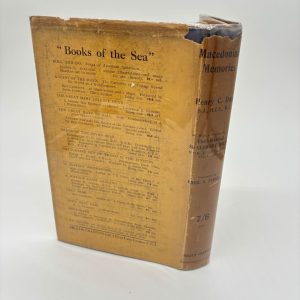
Non-Fiction
...with a preface by Field-Marshal Sir George F. Milne
London, Heath Cranton, 1930.
First edition, first impression. 8vo. Original cloth. Dust-jacket.
A memoir of the Macedonian Campaign of the First World War, prefaced by Field-Marshal Sir George Milne, who commanded British forces in the Salonika theatre.
![General Staff Canadian Army and Air Force. [Exercise Eskimo]. Canadian Army and Air Force Winter Warfare Research Programme](https://lycanthiabooks.com/wp-content/uploads/2026/05/88250-300x300.jpg)
![Alternative view of General Staff Canadian Army and Air Force. [Exercise Eskimo]. Canadian Army and Air Force Winter Warfare Research Programme](https://lycanthiabooks.com/wp-content/uploads/2026/05/88250_2-300x300.jpg)
1944 [-] 1945 Exercise Eskimo "Dry Cold".
Ottawa, Department of National Defence, 1945.
Vol.I & II (only, of 3), 8vo. Original pictorial cloth.
Two volumes of rare military technical reports documenting Exercise Eskimo, a significant joint winter warfare field trial conducted in northern Canada during the final stages of World War II. Involving approximately 1,750 personnel from the Canadian Army and the Royal Canadian Air Force, the exercise was designed to test the impact of sub-Arctic winter conditions on combat efficiency and military equipment across a wide range of operational areas — from clothing, rations, and the army postal service to tanks and heavy machinery. The volumes compile core observations, technical data, prototype equipment evaluations, and formal recommendations for future winter operations, and are illustrated with photographs throughout. One volume includes five large fold-out maps in rear pockets covering the Advance, Withdrawal, Lines of Communication Operations, Air Operations, and Winter Climatic Zones.


Non-Fiction
London, Constable, 1937.
'New edition'. 8vo. Original cloth.
First published in 1922, Belloc's controversial study argues that the Jews constitute not a minority religion but a separate nation.

![Alternative view of [Sammelband].- [Various. Early 20th Century Russian Sammelband]](https://lycanthiabooks.com/wp-content/uploads/2026/05/88238_2-300x300.jpg)
various places, , 1903-7.
8vo. Green cloth with leather spine label lettered and bordered in gilt.
A collection of five scarce Russian language pieces, spanning some of the most volatile years of the early twentieth century Russian history, consisting of fiction (the influential German pacifist novel Lay Down Your Arms! featured on title stamp), worker poetry and important political articles. The works address and represent many of the causes and consequences of the 1905 Russian Revolution (The First Russian Revolution), as for instance raised by Vladimir Nabokov in his autobiography, Speak, Memory, including the harsh conditions for workers caused by industrialisation, the poverty experienced by the peasant population, the spread of revolutionary and liberal ideas, and the disastrous Russo-Japanese War.
1. Lay Down Your Arms! by Bertha von Suttner, published by Altshuler, St Petersburg, 1905. Third Russian edition. Von Suttner's classic anti-war novel first published in Germany in 1889 as Die Waffen nieder! Von Suttner was awarded the Nobel Peace Prize in 1905 also, being the second female Nobel Laureate (after Marie Curie).
2. On the All-Russian Workers' Congress, published by Provincial Colleague, Moscow in 1907, and containing a collection of articles from the Russian Social Democratic Labour Party; authored by: Aleksandr Arkhangelsky, Lazar Solomonovich Yezhov, Akhmed Tsalikov.
3. Songs of Working Life by Fedor Postupaev, published by Donskaya Rech, Rostov-on-Don, 1904 (approved by the censor, May 7 1904). A collection of proletarian poetry, describing both agricultural and industrial life. The publisher's offices were frequently raided by the authorities and their books confiscated or burned as they were seen as inciting worker unrest in Tsarist Russia. Postupaev was a self-taught poet who held radical views, including the immediate confiscation of land from exploiters and its fair and equal redistribution.
4. Songs of Labour, published by Donskaya Rech, Rostov-on-Don, 1903 (approved by the censor, December 4, 1903). An anthology containing poems and songs such as 'It is Dawning', and 'Comrade' by Innokenty Omulevsy, Dubinushka by Leonid Trefolev, Ivan Bunin's 'Worker's Songs', Konstantin Blamont's 'The Blacksmith', and 'Song of the Ploughman' by Aleksey Koltsov, as well as translations of Henry Wadsworth Longfellow, Thomas Hood, and Ferdinand Freiligrath.
5. A Short History of the French People by Paul Lacombe, published by Donskaya Rech, Rostov-on-Don, 1904 (approved by the censor, October 4, 1903). A Russian translation of Lacombe's 1878 French work, significant because Russian revolutionaries regarded the French Revolution as a model for their own movement.


Non-Fiction
London, Lutterworth Press, 1959.First edition, first impression. 8vo. Original boards. Dust-jacket, price-clipped.An account of Attenborough's animal-collecting expedition to Paraguay as part of the BBC's Zoo Quest television series (1954–1964), the fourth volume in the Zoo Quest sequence.


Translated from the Portuguese by J.B. Wood
Clarksburg, VA., Saucerian Books, 1960.
First US edition, first printing. 8vo. Original boards. Dust-jacket, priced $3.75.
A story in the vein of classic contactee George Adamski, in which a nameless alien from the moons of Jupiter, described as a good Christian, conveyed to Felix a series of unorthodox scientific claims and prophecies. Felix later resurfaced as a cult leader and prophet, making predictions about natural disasters and terrorist attacks during a politically turbulent period in Brazil.


Non-Fiction
London, Macmillan, 1933.
First edition, first impression. 8vo. Original cloth. Dust-jacket, publisher's price label of 5s net to upper panel and spine.
George Saintsbury (1845-1933) was one of the most prolific and influential literary critics of the late Victorian and Edwardian periods, holding the chair of English Literature at Edinburgh from 1895 to 1915.


London, Hobart Manufacturing Co., June 1935.
4to. Original pictorial wrappers. Housed in custom cloth case with colour illustration and title label to upper cover and 2 inset illustrations to lower.
A special souvenir issue relating to the French Line's North Atlantic steamship Normandie.


A Survey of Evidence
London, Faber & Faber, 1939.
First edition, first impression. 8vo. Original boards. Dust-jacket, price-clipped.
Sir Ernest Bennett (1868–1947) was a British Liberal MP and psychical researcher who compiled this survey of reported apparitions and hauntings as an evidential study.


n.p., G.P. Putnam's Sons, 1937.
First edition, first printed. 8vo. Original cloth. Dust-jacket, priced $2.50.
A work adapted from the diary of a Scots private during World War I: 'It ends as it began with the sight of the long road unrolling from the opened end of a moving car; first a lorry and last an ambulance.' (jacket blurb)


Non-Fiction
Foreword by Daniel Halévy. Introduction by Edward Crankshaw. Translated from the French by Gerard Hopkins
London, Chatto & Windus, 1951.
First UK edition, first impression. 8vo. Original cloth. Dust-jacket.
Czapski's account of the years following his release from Soviet captivity, during which he was tasked with investigating the disappearance of thousands of missing Polish officers - ultimately murdered by Stalin's NKVD at Katyn.


Non-Fiction
London, Andre Deutsch, 1954.
First edition, first impression. 8vo. Original boards. Dust-jacket.
Sir Harold Scott (1887–1969) served as Commissioner of the Metropolitan Police 1945–53, overseeing Scotland Yard through the difficult immediate postwar period. Accompanied by a 3½ page autograph letter from the author.


An investigation into Satanism in England and the International Black Magic Conspiracy
Poole et al, Blandford Press, 1987.
First edition, first impression. Signed by the author. 8vo. Original boards. Dust-jacket.
Appearing at the height of Britain's "Satanic Panic" of the late 1980s, this work belongs to a recognisable genre of sensationalist occult investigation publishing of that period, alongside works by authors such as Doreen Irvine and Kevin Logan.


Non-Fiction
London, Dent, 1931.
First edition, second impression. 8vo. Original decorative cloth. Dust-jacket, priced 4/6.
A perceptive travel and social commentary on 1920s Germany by the novelist, playwright, feminist, and suffragette Cicely Hamilton. Surveying political, cultural and social life across the fragmented postwar states, Hamilton records both the optimism of the Weimar years and the tensions that would culminate in Nazism. First issued in 1931, this later, cheaper edition (likely late 1933) incorporates a newly added chapter, "Postscript: The New Order," addressing the Nazi regime - an unusually early and appended account of Hitler's Germany within an existing work.Illustrated with additional photographs, including images of Hitler at the Nuremberg Rally and of young Nazis, the volume also reflects Hamilton's feminist concerns. In discussing Nazi pronatalism and racial policy, she wryly questions how Germany would feed its projected population increase, only to be told, ominously, that all would be well "when we have colonies."


Non-Fiction
Brussels, Editions Est-Ouest, 1945.
First edition. 8vo. Original pictorial wrappers.
Scarce; OCLC locates only 5 copies in the US (USHMM, JHU, Hoover, LOC Harvard). One of the earliest substantial eyewitness accounts of Dachau, published only months after its liberation by American forces in April 1945. Arthur Haulot, a Belgian journalist and resistance member, was arrested by the Gestapo in 1941 and deported first to Mauthausen and then to Dachau. There he served as a nurse and helped found the International Prisoners' Committee. After liberation he remained in the camp to assist with its administration before returning to Brussels in June 1945. Haulot later travelled in Germany as a witness at the Dachau trials and wrote extensively on the atrocities of the Nazi regime and its assault on fundamental freedoms.


London, George Allen & Unwin, 1929.
First UK edition. 8vo. Original purple cloth. Dust-jacket, priced 12s6d.
Müller-Freienfels was a prominent social critic and philosopher whose work combined philosophy, psychology, and the social sciences, emphasising the role of unconscious and symbolic forces in shaping culture. His ideas on the "collective soul" and national psychology resonated with the intellectual climate of 1930s Germany and, while his precise influence on official Nazi doctrine is difficult to measure, his thought aligned in part with contemporary nationalist currents. He joined the Nazi Party in 1933, later distanced himself, and by 1942 was declared "inactive" and placed on the Index of prohibited authors.His legacy became the subject of post-war controversy. In 1948, following the publication of his letter in The Journal of Aesthetics and Art Criticism, Dr Alfred Einstein publicly accused him of having been a "leading Nazi aesthetician," prompting a sharp exchange that illustrates the fraught reassessment of German intellectuals after 1945.


Non-Fiction
The Story of Franz Biberkopf
New York, The Viking Press, 1931.
First US edition. 2 vols. 8vo. Original light grey cloth blocked in red & black. Dust-jackets. Lacking original slip-case.
Translated by Eugene Jolas. First published in Germany in 1929, this landmark Weimar novel follows Franz Biberkopf, an ex-convict determined to go straight after his release from Tegel Prison, only to be drawn back into Berlin's criminal underworld amid economic hardship and mounting political extremism. Döblin's innovative, collage-like style weaves street slang, headlines, and interior monologue into a vivid portrait of the city. This is the first English translation, by Eugene Jolas, co-founder of the avant-garde journal transition—an important but often criticised version, noted for its difficulty in fully conveying the novel's linguistic energy and dense vernacular.